
RBC Estimation / Technical Assurance

How do we make sure an estimate is ready to trust?

Accuracy is not a promise made after the work is finished. It is a controlled path from the first drawing to the released estimate – with named owners, source evidence, independent checks and a documented closeout for every finding.

Inputs locked

The team works from a controlled drawing and specification set.

Quantities verified

A senior estimator independently tests coverage and corrections.

Release controlled

The estimate cannot be issued while critical or major findings remain open.
The operating principle

Quality is not one careful person. It is a system that makes every decision reviewable.

No estimating process can honestly promise zero risk. RBC reduces preventable errors by making the work traceable, independently reviewable and impossible to release without defined evidence.

01 / SOURCE

What controlled the decision?

Drawing sheet, detail, specification clause, addendum, client direction or dated pricing source.

02 / CHECK

How was it tested?

Method, acceptance criteria, sample extent, checker and date are attached to the work.

03 / CLOSURE

What changed and who approved it?

The original condition, correction, independent recheck and release approval remain in the record.

Research-informed quality controls

The evidence says accuracy depends on more than the takeoff.

RBC uses the Construction Cost Estimate Accuracy Index research as one validation lens for our quality system. The study invited 90 construction estimating experts, received 66 responses, identified 15 significant accuracy factors across four categories, and tested the model on three completed projects.

01 / INFORMATION QUALITY

Clear documents. Complete cost information. Explicit assumptions.

RBC answers this with controlled inputs, revision tracking, specification checks and a written scope basis.

02 / PROJECT CHARACTERISTICS

BOQ accuracy. Complexity. Duration. Construction method.

RBC calibrates the measurement approach and review depth to the project, not to a generic checklist.

03 / TEAM CAPABILITY

Estimator skill. Similar-project experience. Management control.

Named ownership and an independent senior review prevent the estimate from depending on one person.

04 / EXTERNAL CONDITIONS

Pricing, availability, waste and economic conditions.

RBC validates cost sources, dates, location, productivity, quotes and commercial allowances before release.

Research reference: Ahmed H. Ibrahim and Lamiaa M. Elshwadfy, “Assessment of Construction Project Cost Estimating Accuracy in Egypt,” The Open Civil Engineering Journal, 2021. We use the identified accuracy factors as a control lens; RBC’s seven-stage workflow is our own operating system.

The controlled journey

Seven gates between the source files and the client issue.

Each stage has a specific risk to catch, an accountable owner and an exit condition. Passing a stage means evidence exists – not simply that someone says the work is complete.

01

Inputs locked

Risk caught: outdated drawings, missing addenda or unclear boundaries

Project Intake and Document Control

We confirm the client brief, trade boundaries, drawing index, revisions, addenda, deadline and measurement standard. The team works only from the controlled input register.

Owner: Estimator + Project Lead   |   Exit condition: Inputs locked

02

Gaps resolved

Risk caught: scope gaps hidden between drawings, notes and specifications

Scope Review and Clarification

Disciplines are compared. Omissions, conflicts, inclusions, exclusions, assumptions and unresolved items are recorded against marked drawings and specifications.

Owner: Estimator + Senior Estimator   |   Exit condition: Gaps resolved

03

Measured work

Risk caught: wrong scale, wrong units or quantities without a source

Quantity Takeoff Preparation

Scale and units are calibrated before counts, lengths, areas and volumes are measured. Every material quantity carries its sheet, detail, formula and waste-factor basis.

Owner: Estimator   |   Exit condition: Measured work

04

Coverage proved

Risk caught: work missed, counted twice or corrected without verification

Independent Quantity Verification

A senior estimator verifies omissions, duplicates, units, assemblies and high-value quantities. Corrections are rechecked independently before the stage can close.

Owner: Senior Estimator   |   Exit condition: Coverage proved

05

Cost basis proved

Risk caught: stale rates, unsupported labor factors or hidden commercial assumptions

Pricing and Commercial Validation

Material, labor, productivity, location and date, equipment, subcontract quotes, overhead, profit, contingency and tax are checked against dated evidence.

Owner: Pricing Engineer   |   Exit condition: Cost basis proved

06

Issue authorized

Risk caught: a correct takeoff becoming an inconsistent client deliverable

Deliverable Reconciliation and Release

Takeoff is reconciled to the bill of quantities. Totals, formulas, alternates, qualifications, filenames and open items are tested before release authorization.

Owner: Quality Reviewer   |   Exit condition: Issue authorized

07

Learning captured

Risk caught: an issue being fixed without a traceable cause or prevention step

Post-Delivery Issue Control

Client feedback is logged, reproduced from the issued file, classified, corrected, independently rechecked, communicated and trended so the cause does not disappear.

Owner: Quality Lead   |   Exit condition: Learning captured

The system at a glance

Follow the complete quality path from input to release.

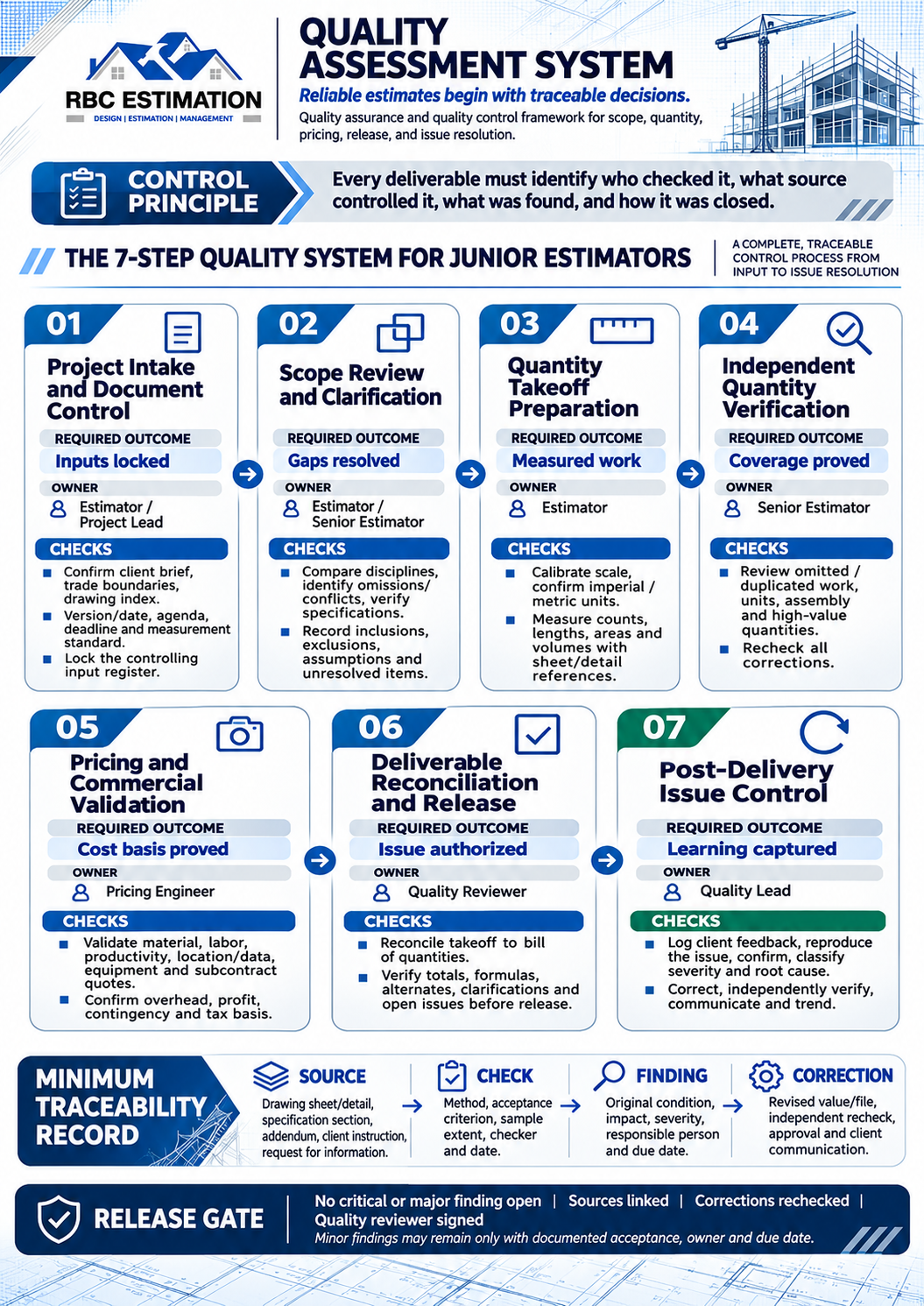
The infographic below shows the seven stages, named owners, required outcomes, traceability record and final release gate in one view.

RBC Estimation Quality Assessment System – Revision 1.1. The release gate requires linked sources, rechecked corrections and quality-reviewer authorization.

The minimum traceability record

A number is not defensible until its evidence chain is intact.

01

SOURCE

Drawing, detail, specification, addendum, client direction or dated market source.

02

CHECK

Method, criteria, extent, checker and date used to test the work.

03

FINDING

Original condition, severity, impact, owner and due date.

04

CORRECTION

Revised value or file, independent recheck, approval and client communication.

RELEASE GATE

No critical or major finding open   |   Sources linked   |   Corrections rechecked   |   Quality reviewer signed

Minor findings can remain only with documented acceptance, an owner and a due date.

If a concern is raised

We do not close a client issue from memory.

The issued file and controlling source are reopened. The condition is reproduced, assessed, corrected and independently rechecked before the finding is closed.

01 / LOG

Capture the exact concern

Client wording, issued file, version, item and date.

02 / ROUTE

Assign the control category

The issue is routed to the stage and owner that controls the source.

03 / REPRODUCE

Verify the original condition

The issued file and controlling source are opened together.

04 / ASSESS

Record impact and cause

Severity, root cause, owner and due date are documented.

05 / CORRECT

Revise and recheck

Source-linked work is corrected and independently verified.

06 / CLOSE

Approve, notify and learn

Evidence is archived, the client is informed and the cause is trended.

CRITICAL

Bid risk, wrong scope basis or an unreliable estimate stops release and escalates to the quality lead.

MAJOR

A client-facing quantity, pricing or deliverable error is corrected and independently verified before reissue.

MINOR

A low-impact or presentation defect is logged, corrected and trended; any acceptance remains documented.

Confidence before the bid

Send the plans. We will control the inputs, prove the quantities and document the cost basis.

RBC reviews the scope first, confirms the quote and turnaround, and applies the same controlled quality path to every deliverable.