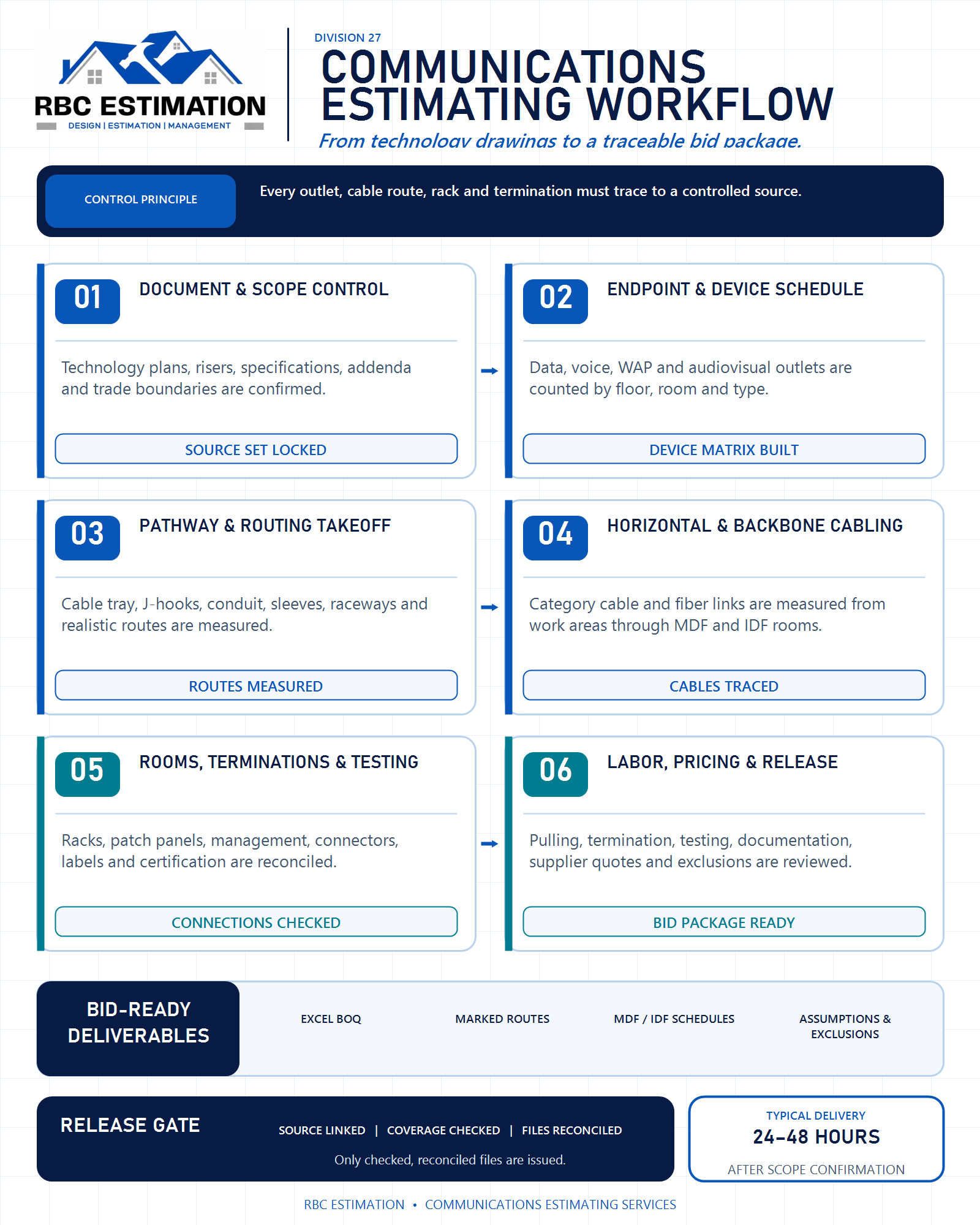
Every communications quantity stays connected to its system path.
Division 27 scope is more than a device count. The estimate follows the connection from the work-area outlet through pathways, telecom rooms and backbone infrastructure.
Structured cabling
Cat6 and Cat6A horizontal cabling, outlets, faceplates, jacks and patch cords.
Fiber backbone
Single-mode and multimode fiber, strands, enclosures, connectors and splicing.
Telecom rooms
MDF/IDF racks, cabinets, patch panels, grounding and cable management.
Wireless + AV
Wireless access points, audiovisual outlets and supporting cabling shown in scope.
Pathways
Cable tray, J-hooks, conduit, raceway, sleeves, supports and firestopping interfaces.
Testing + closeout
Termination, labeling, certification results, record drawings and handover documentation.
Endpoint → route → telecom room → backbone → release
The page mirrors how the work is installed, letting your estimator verify that device counts, cable quantities, rooms and testing are all tied together.
ENDPOINTS
Count by room, type and drawing symbol.
HORIZONTAL
Measure usable routes and service loops.
MDF / IDF
Schedule racks, panels and terminations.
BACKBONE
Trace copper and fiber between rooms.
See the full control sequence at a glance.
This trade-specific workflow keeps scope interpretation, measurement, pricing and independent review visible instead of reducing the work to a bland checklist.
Four stages from controlled documents to bid-ready files.
The infographic summarizes the controls; these native Elementor cards explain how the estimate is actually built and can be edited later.
Control the documents
Technology plans, risers, specifications, addenda and scope boundaries are logged before measurement.
Build device and route schedules
Endpoints are counted and cable/pathway routes measured by floor, system and destination.
Price installation and testing
Materials, pulling, termination, labeling, certification, equipment and labor are priced together.
Reconcile and release
BOQ, room schedules, marked routes, supplier pricing and assumptions are checked before issue.
Files your team can review, price and issue.
The output is organized for contractor bidding, subcontractor pricing, supplier quote comparison or internal cost review.
Excel BOQ
Itemized devices, cable, pathways, equipment, labor and units.
Marked routes
Color-coded plans showing measured coverage and routing basis.
MDF / IDF schedules
Room-by-room racks, panels, backbones and terminations.
Cable schedules
Horizontal and backbone quantities organized by type and location.
Labor + testing
Pulling, termination, certification and closeout activities.
Assumptions + exclusions
Trade interfaces, routing rules, alternates and unresolved items.
Communications scope is separated from adjacent systems.
We identify whether security, fire alarm, audiovisual, electrical power, door hardware and shared pathways belong in Division 27 or another package. That prevents duplicated infrastructure and missing responsibility.
SOURCE
Controlled drawing, detail, specification, addendum or quote.
CHECK
Scope method, unit, coverage, interface and reviewer are visible.
RELEASE
BOQ, marked plans, pricing and assumptions agree before issue.
Before you send the plans
Straight answers about csi division 27 estimating.
Can you use our low-voltage bid form?
Yes. Send the workbook or cost-code structure at intake and we will organize the estimate to match.
How are cable lengths calculated?
We use drawing-based routes through the actual pathway and telecom-room layout, with service loops or waste only when requested or justified.
Do you include testing?
Yes when specified. Certification, labeling, commissioning support and closeout documentation are carried as separate scope.
What should I send?
Technology plans, risers, specifications, addenda, reflected ceiling plans where relevant, bid form and deadline.